

Welcome to my ultimate guide to the negatives of eating too quickly, and the benefits of eating slow – and how to do it.
Let’s face it, eating is fun. But it’s easy to do it badly.
We’re not talking about what’s on your plate, but how you actually eat it.
In this in-depth article, we’re exploring the drawbacks of eating food fast. We’ll then look towards France for inspiration for eating slowly. I’ll then give you some very actionable tips for how to slow down – tips that actually work.
Of course, if you’re looking for something in particular, check out the contents list to jump to the section most relevant to you. 👇
- The problem with eating too quickly
- The saddest thing about eating too quickly
- Is a trip to France the cure?
- How to eat slowly
- Use these planned actions for guaranteed results:
- Ready to get started?
- The final word on eating too quickly

The problem with eating too quickly
Allow me to ask… can you relate to any of these scenarios?
- Crammed a sandwich into your mouth while driving
- Scoffed toast while jogging to the bus stop
- Eaten lunch standing over the sink
- Completed a full pack of biscuits at your desk
- Eaten your dinner quicker than your dog
Eating too quickly has many negatives.
Aside from the potential of choking on food that hasn’t been chewed properly, partially chewed food arrives in our stomach in the form of large lumps.
Because of this, the stomach has a much tougher time in its task of creating chyme – the pulpy mix of partially-digested food, water, hydrochloric acid and digestive enzymes.
When this food is not broken down properly, the GI tract becomes more susceptible to common digestive issues. These include bloating, indigestion, trapped wind and… untrapped wind (yeah, farting). 😬
The saddest thing about eating too quickly
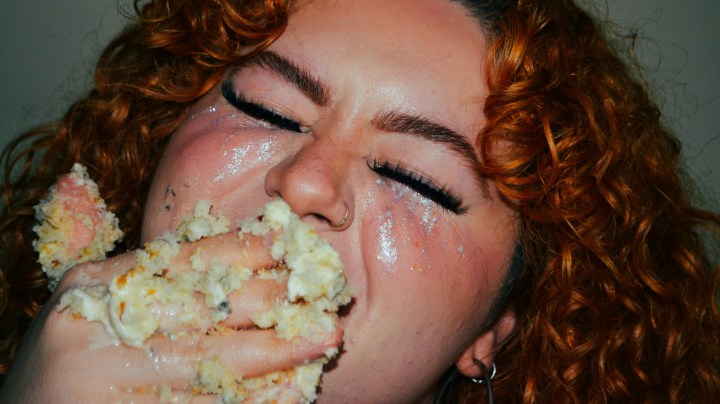
One of the saddest things about eating too quickly is that we don’t actually get to enjoy our food.
Eating is one of life’s true pleasures, but by rushing our meals we don’t get to truly live the experience.
You may enjoy the feeling of that large slice of pizza sliding down your throat and into your belly, but did you actually taste the flavours and textures?
If not, you might as well have been eating something with fewer calories and saturated fat.
It’s like ripping open all of your Christmas gifts in five minutes. An absolute frenzy followed by a feeling of dissatisfaction, and the desire to do it all over again instantly.

Eating too quickly can cause weight gain
Emotions aside, eating too quickly can cause overeating, whether that’s hot dogs or a basic plate of pasta.
In fact, it was plates of pasta that subjects were fed during a landmark study on eating speeds at the University of Rhode Island in 2007. 🍝
The study saw 30 women served the same pasta dish on two separate occasions.
On the first, the women were told to eat as quickly as comfortably possible. On the second occasion (a different day) the same women were told to eat slowly, with each mouthful chewed at least 20 to 30 times.
The results showed that eating the meal quickly resulted in 646 calories consumed in nine minutes, while eating the meal slowly led to 579 calories consumed in 29 minutes.
The maths has been done for you: the slow-eating test resulted in 67 fewer calories consumed in 20 additional minutes. This means that these women were able to spend more time enjoying their food, while eating less of it.
Again: they spent more time enjoying food, while eating fewer calories.

Is a trip to France the cure?
Let’s jet to the Art Nouveau cafés of Paris, where our first remedy to the modern world of eating too quickly awaits.
Mangez lentement. Eat slowly.
France is traditionally a land of brie, baguettes and beignets. Yet, despite consuming so many calorific foods, the country historically has a reputation for producing some of the slimmest people in the world.
This is the so-called French paradox.
Many factors play a part in this ability to stay lean when faced with so much saturated fat. This includes good portion control and positive snacking habits, yet the one we are homing in on is the culture of eating slowly.
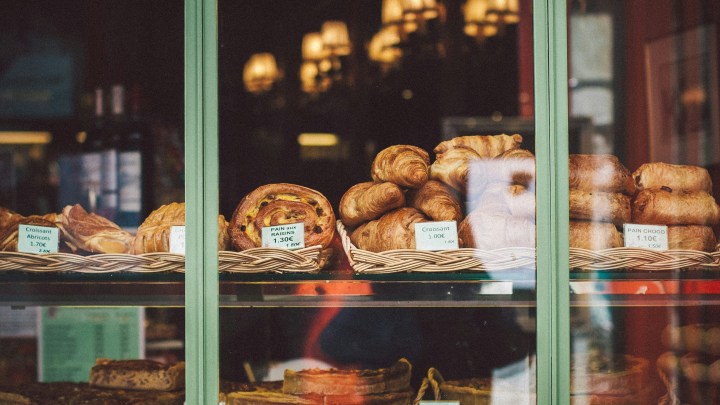
It’s safe to say that the French take mealtimes seriously. In France, eating becomes priority as soon as the plate hits the table, making them the perfect subjects to study for slow eating.
This has actually been done several times, including as part of an Organisation for Economic Co-operation and Development’s (OECD) ‘Society at a Glance’ report*.
This investigation revealed that the French spend two hours and 13 minutes every day eating and drinking.
In comparison, people in the UK spend one hour 18 minutes eating, while Americans blitz through their meals in one hour and two minutes.
This is more than twice as fast as the French.
*While the original report is no longer available online, you can read about it via a Reuters story from 2009.
The gap between France and the rest
Let’s look at the gap between France and the US more closely. If you have spent any time in either of these countries, perhaps it comes as no surprise.
- In a French restaurant, it’s easy to spend a couple of hours lingering over a meal. Enjoying the company of those around you as much as the food on your plate.
- In the United States, eating is usually an in-feed-out affair. The quicker the better. If you happen to be with company, you can always catch up afterwards as you pay the bill.
But we can’t blame the Americans. Or the Brits for that matter.
This is just culture.
The habit of slow eating is ingrained into the French from a young age
It continues throughout life.
In French schools, children are often given between 90 minutes and two hours to enjoy their lunchtime meals and playtime.
Meanwhile, American high school children are given just 30 minutes, which includes the time it takes to get into the lunchroom, get served, and eat. Ultimately, in America, if you eat slowly then you lose out.
The UK is not much better – while lunchtimes have traditionally been up to an hour, a 2019 report showed that a quarter of secondary schools now have lunchtimes of less than 35 minutes.
In France, the nation tends to shut down and congregate at the table to enjoy lunch together daily from noon to 2pm.
Shops and public buildings close as friends, families and colleagues unite to break baguette. They’ll even enjoy a glass or two of wine.
What about eating at your desk as we often do in the UK? Sacré bleu!
In fact, until February 2021, it was actually illegal for office workers to eat lunch or dinner at their desk due to a historic French labour law (Article R4228-19 of the Code du Travail).
This only changed temporarily due to the pandemic, but normal business resumed following the crisis and two hours of blissful lunchtime freedom was restored.
Yes, some of this is probably a little romanticised. Some French people probably eat very quickly at their desk every day.
But in general, the French typically have a great relationship with food.
Fortunately, we can certainly take inspiration from France as we look at a way to make this eating style a part of our own lives.

How to eat slowly
Even when you know the power of slow eating and are ready to commit to it for every meal, it’s pretty difficult.
Just as lingering meals are part of French and even Italian culture, eating too quickly is common practice in the UK, USA and other countries struggling with obesity.
This is why our good intentions to slow down can fly out the window when we are confronted with a fork, an appetite, and a bowl of something tasty.
We have to accept that in the UK or USA, we are never going to change the national culture into one of two-hour lunch breaks and prolonged evening meals.
But how do we encourage ourselves to stop eating too quickly and slow down?
We can rely on one thing to make this easier: planned actions.
Planning actions ahead of our meals makes committing to slow eating so much easier.
Actions are tangible. You don’t have to ask the question, ‘Am I eating slowly enough?’ mid-bite because you are following specific actions and you already know the answer.
Clarity is always more effective than ambiguity in these circumstances.
Use these planned actions for guaranteed results:
Action #1: Put down your utensils while you chew
How often have you found yourself loading up the fork ready for your next bite while you are still chewing? It’s common, but it’s very counterproductive to our goals.
Instead, as soon as you begin chewing a mouthful, put down your knife, fork, spoon, spork, or whatever you are using.
After you swallow, only then should you pick up the utensils to continue eating. Continue this pattern and watch how much slower your meals become.
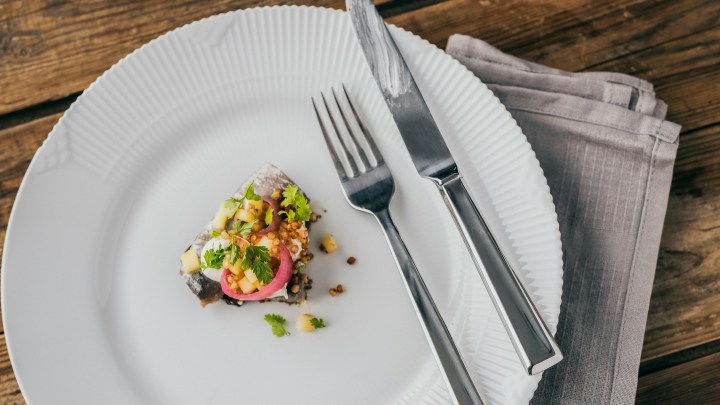
Action #2: Do something between mouthfuls
Similar to above, this action will prevent you from loading your fork ready to go. What you actually do between the mouthfuls is up to you.
For example, you can take a small sip of water after you swallow each mouthful. This doesn’t have to be a large gulp. Just enough to moisten your lips or clear your mouth is enough to slow you down.
Or try taking three breaths. These don’t have to be particularly deep. Three regular breaths will give you a few seconds of breathing space (pun intended…).
Action #3: Pace yourself to the slowest eater
I love this one.
When eating with others, determine the slowest eater and pace yourself to them. Take a bite when they do and pause when they pause. Aim to finish your meal at the same time.
This technique is particularly good if you are eating with a toddler. ‘Come on now, eat up… no, put the Play-Doh down and come back to the table… FOR GOD’S SAKE, HURRY UP!’
It may take them three minutes to eat one mouthful of mashed potato – and now you can turn this lack of urgency to your advantage as you extend your meal to match them.
Note: whoever your chosen slowest eater, don’t let on that you are using them as a timer, lest they change their speed. This is your little secret.

Action #4: Time yourself
Don’t have a toddler or another slow eater to hand? Another sensible option is to time yourself, using a clock, watch or smartphone.
First, eat a meal as you normally would and time yourself. How long did it take you? Five minutes?
Make a meal of a similar size last six minutes next time. Then seven minutes the next day. Do this up until you can reach around 20 minutes.
Action #5: Set yourself a minimum number of chews
This is a good one when you are alone, but less effective if you want to enjoy good conversation while you eat.
Set yourself a minimum number of times to chew one mouthful, then stick to it.
Studies and anecdote both suggest that around 30 times is the magic number. However, aim for around 40 chews for tougher foods (nuts, meat, seitan) and around five to 10 for moist foods (watermelon and stews).
Action #6: Use chopsticks to eat your meals
Take inspiration from the Chinese. Chopsticks can slow everything down!
It’s probably best to keep this technique for dining at home, as you may come across a little strange whipping out a pair of chopsticks in a burger bar.
Of course, try this technique with noodle and rice dishes, but give it a go with breakfast cereal, sandwiches, and roast dinners.
Just cut your food into an appropriate size and tuck in.
It works well for snacks too. Eating crisps, olives, and popcorn one at a time can really enhance the enjoyment and reduce the amount you eat overall.
It’s also kind of fun, and that’s exactly why you should try it!
Bonus Tip
Another way to set yourself up for success is to give yourself enough time to eat in the first place. Around 20 to 30 minutes is sensible; longer is ideal.
This may be difficult if you overslept and have five minutes to shower, dress, eat, take the dog for a walk, and get to the office.
But in many cases, we are not as rushed off our feet as we believe. For example, when you are eating your evening meal with your family, or even alone, you probably have at least half an hour to spare. So set that time for eating, and only eating.
Knowing you have the time to concentrate on and enjoy your food will put you in a healthier mindset.
Ready to get started?
Importantly, don’t try to implement all of the above tips at once. This will only overwhelm you and you will likely give up before you truly start.
Choose just one or two of these actions and commit to using them at dinner every day for a week.
When you find you are able to do it with ease, then add your chosen actions to your lunch, and – when you are comfortable – to your breakfast. Eventually you can learn to snack slowly too.
If you still find yourself eating too quickly, that’s fine. It’s to be expected.
When you catch yourself preloading the fork or bolting your food, simply put down your utensils and take a minute to re-focus.
Slow eating isn’t habitual for you yet and this will take practice.

The final word on eating too quickly
Eating too quickly is a big contributor to weight gain as you interrupt your body’s natural fullness alarms, which can lead to overeating.
Additionally, fast eating can cause problems in your digestive system and lower your satisfaction with food.
To eat slowly, commit to practicing some of the actions we have discussed. These include putting your utensils down in between bites, pacing yourself to the slowest eater, timing yourself, or even eating with chopsticks.
The result will be better digestion, more enjoyment of less food, and a greater feeling of self-control.
Good luck! 😋
 Planet Health
One thought on “The Cure to Eating Too Quickly (A French Exploration)”